
Sonic Digest #004
Live audio, sound archives, and listening through bodies, books, rooms, and tools

Welcome to the fourth Sonic Digest, a slower dispatch from Sonic Field for readers who prefer the recent signals in a more condensed form.
June was dense. We published work on AI audio, archives, books, tools, sound art, acoustic politics, literary listening, sonic computation, and the changing shape of the site. Several currents ran through it all: audio as infrastructure; listening as cultural and bodily knowledge; the archive under pressure; and sound increasingly generated, indexed, trained on, performed, and contested.
1. The site became a lab as AI audio became infrastructure
The month opened with Sonic Field v2, a note on the new version of the site and the integration of Labs, Lexicon, Journal, Vault, Paths, and open experiments. AKOÚŌ, Earworm, Akousmata and ORAM now sit beside the editorial archive as tools and methods for studying agentic listening, artificial soundscapes, computational sound, and the politics of machine audition.
That expansion also shaped how we covered audio technology. Stable Audio 3 marked a move toward generative audio designed for editing and local use, with open weights, inpainting, variable duration, and workflows closer to sound design than one-shot prompt-to-file generation.
From inside the studio, Ableton Extensions SDK opens Live to JavaScript tools followed the same question. Scripts, WebViews, automation, file workflows, and offline analysis make Live addressable in new ways. The DAW becomes a surface for computational agents, small tools, and studio-specific automation.
The shift from output to system also shaped AI audio becomes infrastructure, and trust becomes the test. We looked at expressive speech, live translation, streaming ASR, and real-time music models, asking what latency, control, language coverage, deployment cost, and public trust mean once AI audio operates inside communication, performance, and institutions.
Cartesia releases Sonic 3.5 placed text-to-speech and speech-to-text within a single low-latency voice-agent stack. sonicLAB releases SSNN brought another form of machine behaviour into the studio: a 960-neuron spiking neural network used as a live instrument for synthesis and resynthesis.
The field widened in JASA’s June issue, where acoustics, bioacoustics, underwater detection, Bayesian methods, and physics-informed AI appeared together. A sharper turn came through Midjourney turns sound into a body scanner, which followed an image-generation company into proposed medical sensing built from ultrasound, water, sensor arrays, and AI reconstruction. Sound, again, becomes infrastructure.
2. Archives, datasets, and sonic memory came under pressure
One of June’s strongest threads for us was the archive as a technical and cultural field under pressure.
AI Watchdog reaches the sound archive drew on The Atlantic’s music-dataset investigation to ask what happens when recordings, voices, styles, and listening habits become training material. The question extends beyond whether a track appears in a dataset. It reaches rights, search tools, local models, artist protocols, and the listening relations that can survive once recorded sound becomes model substrate.
At a different scale, Syrian Cassette Archives presented a bilingual online initiative preserving Syria’s cassette era through digitized tapes, cover scans, interviews, and research. The cassette appears here as a music carrier, a form of social memory, an informal network, and a fragile historical medium.
A new CCRU archive opens onto sonic fiction and cybernetics turned toward uploaded talks, audio, mixes, texts, and folders around CCRU, Kodwo Eshun, AUDINT, Mark Fisher, Orphan Drift, jungle, hauntology, cybernetic theory and much more. For sound research, its route through these materials treats sonic fiction as method rather than nostalgia.
The literary work extended this archival thread. Telepoetics brought the telephone into the field through an open-access Edinburgh University Press volume on voice, network, medium, and literary form. Echo Otherwise listened across ancient and contemporary poetry through sound and loss. The Future is not Lost turned toward anti-hauntology, music, technology, and the making of new worlds.
Across these pieces, memory emerged through mediation: tape, dataset, phone line, poem, archive upload, and future-making sound.
3. Listening moved through politics, race, language, and the body
June’s books and essays also treated listening as a way of studying place, power, identity, and bodily knowledge.
Geographies of the Ear listens to Barcelona after Franco followed Tania Gentic’s work on echoic memory, colonial listening, migration, radio, punk, drag, antigentrification protest, and the sonic politics of the city. Masimba Hwati publishes Chidzimbahwe Philosophies of Sound shifted the theoretical ground toward Indigenous Zimbabwean philosophies of sound, ethics, struggle, and everyday listening.
The Quiet Zone examined race, silence, quiet, noise, and the sound of listening in American life. The Listening Glossary assembled another collective vocabulary, with Hannah Kemp-Welch bringing together hundreds of entries on non-cochlear, machine, interspecies, ecological, and experimental listening practices.
The body came to the foreground in several posts. On the (im)possibility of listening to oneself approached trauma, memory, and the difficulty of hearing oneself through Maria del Rosario Acosta Lopez’s volume in the Listening Pamphlets series. Soundsystem as pedagogy read Roger Robinson’s essay on bass culture as a school where sound teaches through bodies before history becomes language. Catriel Nievas and listening as affective space gathered group walks, domestic vibration, field recording, memory, ambient practice, and Deep Listening.
Across them, listening became situated work: political, racialized, embodied, inherited, practised, and shared.
4. Rooms, objects, instruments, and small worlds
One final cluster stayed close to objects, rooms, instruments, and material listening.
mur mur and the speaker as a small world looked at OIO and Mattering’s prototype speaker, which generates an endless, small, simulated audiovisual ambient worlds rather than fixed loops. MPa Sound System treated the room as a speaker assemblage, folding floor discs, cushions, zippers, an iPhone performance, and the listeners themselves into the transmission system.
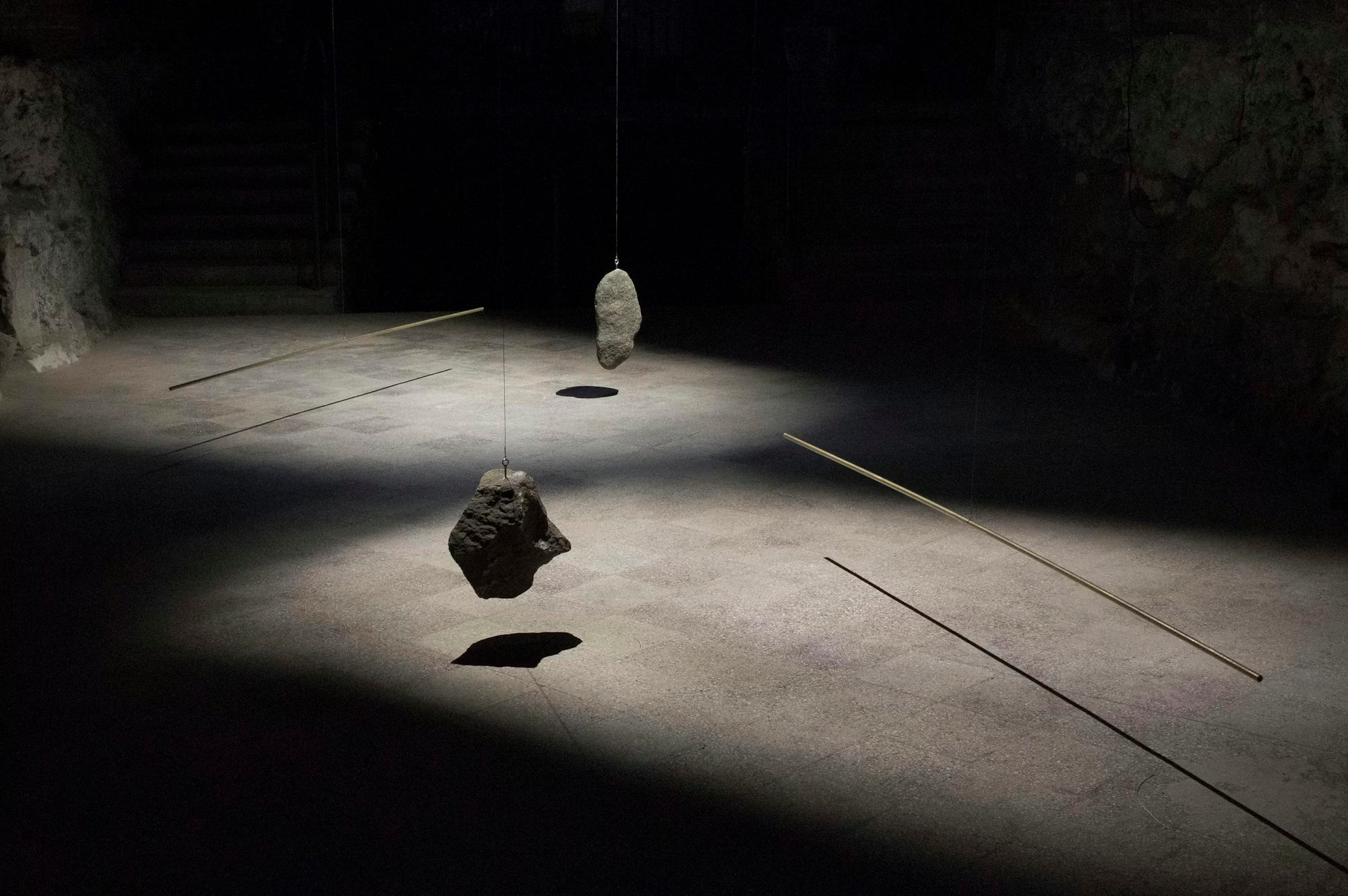
Terrestrial Tales suspends stone, brass, and gravity entered Cédric Van Parys’s kinetic installation, where granite, brass rods, wire, rotation, and a former Ottoman arms depot form a slow acoustic and sculptural situation. An Alchemy of Sounds in Crises traced sonic practices through crisis, archives, bodies, recipes, maps, and paper. Acousmonium Handbook returned to the loudspeaker orchestra through INA grm, acousmatic diffusion, spatialisation, and the practice of projecting sound into space.
These pieces brought June’s larger questions back to matter. Sound appeared as furniture, sculpture, garment, paper, loudspeaker array, simulated ecology, neural network, room, and body.
The relations around sound
Across June, the recurring question was how relations are built around sound.
AI audio is entering live infrastructure. Archives are being recast as contested datasets. Books reopen listening through race, coloniality, language, trauma, poetry, and political memory. Tools move closer to agents, scripts, local models, and adaptive instruments. Rooms and objects become listening systems. Sonic Field moved in the same direction, expanding from journal and archive toward a public research computational instrument.
There is no single ear for all of this. June needed many ears: archival, bodily, cybernetic, ecological, literary, political, spatial, and speculative. Each hears differently. Each carries its own risks.
Take your time with this batch. The links are many, but they return to one question: how do we listen when sound is being generated, archived, trained on, spatialized, automated, remembered, protected, and reworked all at once?
Our ears are open ✿